

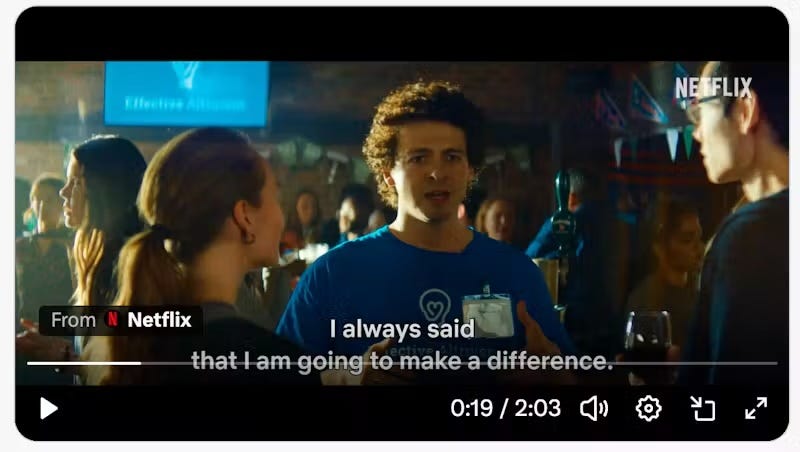
The story of FTX and Alameda riveted American media for months. And for good reason. For the public, it was a glimpse into the elite world of quant trading and EA, crossed with the spectacle of SBF’s glamorous life in Hollywood and DC, topped with the degenerate party culture of crypto.
I’ve speculated to my friends that the only reason we’ve been spared more TV shows about the crisis is that it coincided with the WGA writers’ strike. In that time, cooler heads prevailed: Going Infinite came out, people went to jail, and we all came to mostly understand what, exactly, had happened.
Unfortunately, Graham Moore and his fellow writers did not use the gift of time to create a show deserving of this story. And what a shame it is!
Moore tried to explain himself in an interview, saying he didn’t want to reproduce any content that had already been reported. In doing so, he set a truly high bar for himself. Imagine a world where Christopher Nolan wanted to make the Odyssey without filming any of the stories told in the poem.
Actually, this bar is so high, it’s absurd. And Moore missed.
It’s hard for me to tell whether Moore and his co-writer, Jacqueline Hoyt, are deeply cynical about the American viewer or just bad scriptwriters. Either way, they clearly think their audience is incredibly stupid.
Early on, we see Sam’s boss Jim call him into a private office to yell at him for not wearing a suit. It’s an uncanny valley, because SBF’s boss’s name was, in fact, Jim, and SBF did technically lose something like $150m. But I was baffled by the portrayal of Jane Street as some sort of Wolf of Wall Street, traditional financial firm where he was punished for this.
Upon reflection, I realized the showrunners didn’t want to explain what Jane Street was: a fun, nerdy, quirky, and incredibly lucrative outlier on Wall Street. That would be too complicated for us. It would clearly blow our minds and distract us from the really important question of SBF’s virginity.
Which is crazy! People love content about Jane Street. A real show would have presented this bizarre fact about the world, intrigued us, and perhaps asked what parallels it had with SBF’s later tragic fall.
Which brings me to my second gripe with the show: that they insist on portraying SBF as an awkward, put-upon loser.
He was not that. He did not luck into his success.
SBF was a star, up-and-coming trader who was clearing 7 figures by the time he left. He didn’t need to live in his parents’ house upon moving to Silicon Valley; he could easily afford an apartment in San Francisco. He was enmeshed in an elite network of powerful people, who he was ideologically aligned with. Alameda wasn’t a shoestring operation running on $2m, but one that had borrowed >$50m from wealthy EA lenders and could use that money to pay out trading-level salaries.
This doesn't happen by accident. It is an incredible result, born out of immense access, intelligence, and skill.
But the showrunners seem to think it’s too complicated for us to fathom that an MIT graduate could be so successful only 3 years out of college, or that there are tight-knit networks of elites held together by ideas. So instead, they fall back on tired and inaccurate tropes, making SBF an awkward, lonely, broke dork who lives in his parents’ basement.
What is going on? What I see here — and in other content about smart techies, like the movie Artificial — is a basic misunderstanding of what it is to be smart.
If I had to pin it down to one thing, I would ask you to consider the difference between a ‘dork’ and a ‘nerd.’
Dorks are adorable and awkward. They aren’t interested in fitting in; in fact, they might not be able to. They play Dungeons and Dragons and dress weird. Maybe you went to high school with one. They probably grow up to become a government IT worker.
Nerds are people hyper-focused on learning, and you can’t tell because the best ones learn how to fit in extremely well. Sam Altman is a nerd. Elon Musk is a nerd. Every federal judge is a nerd. Most investment bankers are nerds. Most Hollywood scriptwriters, producers and directors are nerds. We, as a society, begrudgingly give nerds power because they build great things with it—as long as they can pretend they’re not nerds. Do you know what a great, critically acclaimed show about nerds is? Billions.
SBF, Caroline Ellison, and the rest of the founding crew at FTX were primarily nerds, not dorks. You don’t run a successful trading firm without learning the microstructure of every crypto exchange, or run a crypto exchange without learning how to run KYC and financial rails in every country on earth.
Sure, this stuff is boring, so you don’t want to put it in your show. Fine. But Billions did it! It can be done!
And it’s important, because the average viewer has probably never really met a nerd—or, if they have, not really understood what was actually going on.
If I’d written The Altruists, I would have written about this strange, beautiful nerd culture. And I would have made my characters actually smart. In fact, I would have pulled from some of the best content available on the internet about how to write intelligent characters. (And it’s by a Harry Potter fanfiction writer, natch.)
Because you can. You don’t have to make up gobbledegook about dropping an egg off a balcony. You could give show-Sam a fair shot: present him with a game with clear rules, or a puzzle that actually makes sense and can be solved, and watch him solve it. There are such puzzles! They can be written! You can’t find them in The Altruists, but you can in better works like Death Note or Ender’s Game. The enemy’s gate is down.
And as part of this, you might teach your viewer something really interesting about the nature of intelligence, and the world of nerds awash in it.
The Altruists' question is how could people so smart be so stupid? Moore’s answer is because of the primal urges of sex and love. How boring. He reduces his characters to the sort of people any sixteen-year-old American kid can imagine.
But the world is a big place, and the altruists do, in fact, live in a deeply alien world to most people. A better show would have shown more of it. The answer to ‘how could people so smart be so stupid’ is not so obvious, and I wish I could leave this show feeling as unsettled as I did after watching You Can See Everything.
Thanks to Austin Chen for discussing the ideas behind this with me!
So what youre saying, in a word, is “bazinga”
I totally agree that the series is a disappointment and gets fundamental things wrong and relies on old, boring tropes that have nothing to do with the situation. On the other, it is Netflix and probably aiming for lowest common denominator appeal and the more intelligent you make the characters the fewer audience members you have that can follow it.
BTW - I like the egg-dropping riddle and really enjoyed solving it back in the day!